Why Area and Perimeter Are Confusing
Many children mix up area and perimeter, especially when questions get more complicated. If your child only remembers the formula, they might not fully understand what these measurements mean (Fang et al., 2025). Area is the amount of space inside a shape. Perimeter is the total distance around the edge.
The Key Challenge: Compound Shapes
Compound shapes combine simpler shapes into outlines such as L-shapes or rectangles with notches. The challenge is deciding how to break them down and working out lengths that are not labelled. Children also need to distinguish between the space inside the shape (area) and the distance around its boundary (perimeter).
A Simple Routine for Compound Shapes
Here’s a routine you can use with your child when working through compound shape questions:
- Look at the question and check if it asks for area, perimeter, or both.
- Help your child find any missing side lengths using the measurements given in the question.
- Break the shape down into rectangles if it helps.
- Add up the areas for each rectangle to get the total area, or add up all the outer sides for the perimeter.
- Double-check the answer by carefully looking at each step.
Ask your child to explain why they chose each step. Their explanation can reveal misunderstandings that a correct answer alone might hide.
Example: Solving a Compound Shape Problem
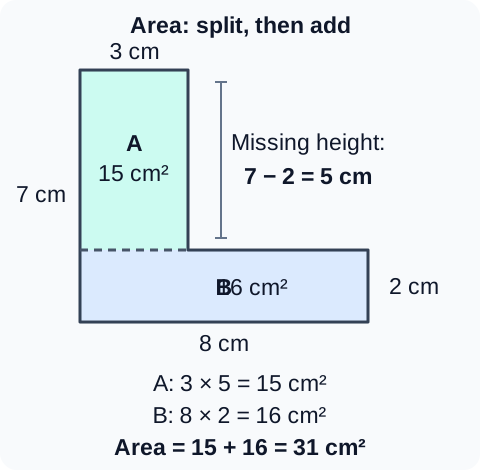
In the diagram, rectangle A reaches from the top of the shape to the bottom arm. Its height is 7 − 2 = 5 cm, so its area is 3 × 5 = 15 cm². Rectangle B covers the full bottom arm: 8 × 2 = 16 cm². Adding these non-overlapping areas gives 31 cm².
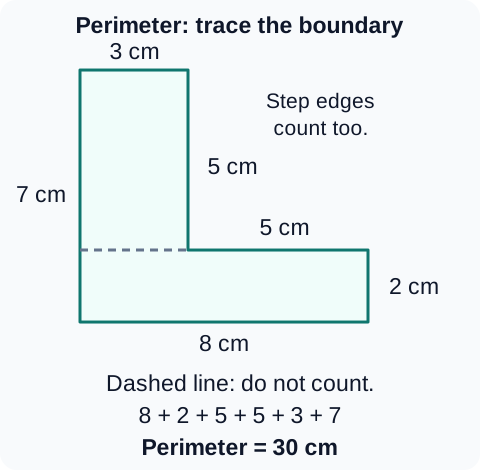
For perimeter, the missing horizontal edge is 8 − 3 = 5 cm. Starting along the bottom and following all six boundary edges gives 8 + 2 + 5 + 5 + 3 + 7 = 30 cm. The diagram below shows why the inward step counts but the dashed dividing line does not.
Common Mistakes
- Guessing missing lengths: use the labelled measurements rather than measuring the drawing.
- Overlapping rectangles: when splitting the shape for area, count each part once.
- Counting the wrong edges: include the inward step in the perimeter, but exclude internal dividing lines.
- Mixing up units: write area in square units (cm²) and perimeter in length units (cm).
If decomposition is the problem, practise decomposition
Older primary students in England face tougher area and perimeter problems, especially with missing measurements. If a child struggles with compound shapes, they need practice breaking shapes into rectangles, finding missing sides, and deciding how to approach the problem.
The DrillDown Prep Deconstructing Shapes Practice Test Worksheets help by offering targeted practice that builds these specific skills.
Summary
Children often get stuck when area and perimeter questions move beyond simple rectangles. The hardest parts are working out missing information and breaking down compound shapes. Helping your child practise these steps—and talk about their thinking—can build real understanding instead of just memorising formulas.
References
- Fang, X., Ng, D. T. K., Tam, W. T. & Yuen, M. (2025). Design mobile computational thinking-integrated mathematics lessons based on the 5E instructional model for primary students. Educational Technology Research and Development, 73, 2809–2838.
- Department for Education (2021). National curriculum in England: mathematics programmes of study. GOV.UK.