Imagine a child dividing a chocolate bar to share with friends, unsure whether splitting it into eighths or thirds will yield a bigger piece. This everyday dilemma highlights a key challenge many children face: understanding how to correctly order fractions.
A child might be able to add fractions, simplify them, or find a common denominator, but still hesitate when asked:
Which is larger, or ?
Ordering fractions tests something different from following a calculation method. It checks whether a child understands the size of a fraction itself.
Mathematicians call this fraction magnitude: where a fraction sits on the number line and how large it is compared with other numbers. A student may know the procedures for working with fractions but still struggle to understand what a fraction represents.
Why whole-number thinking causes mistakes
Before learning fractions, children become used to the idea that bigger numbers mean larger amounts.
8 is greater than 5.
72 is greater than 41.
Fractions do not always follow this pattern.
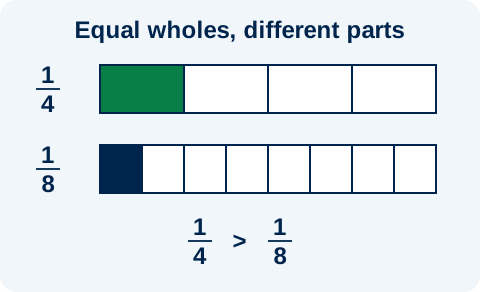
For example, a child may think is greater than because 8 is greater than 4. In fact, dividing something into eight equal parts creates smaller pieces than dividing it into four, so is smaller than .
The numerator and denominator aren't separate whole numbers. The denominator shows how many equal parts the whole is divided into, while the numerator shows how many of those parts are being considered.
A similar mistake happens when a child says is greater than because 5 is greater than 2. Eighths and thirds are different-sized parts, so comparing only the numerators does not tell us which fraction is larger.
What fraction magnitude means
It helps to see a fraction as a single number rather than simply a top number over a bottom number.
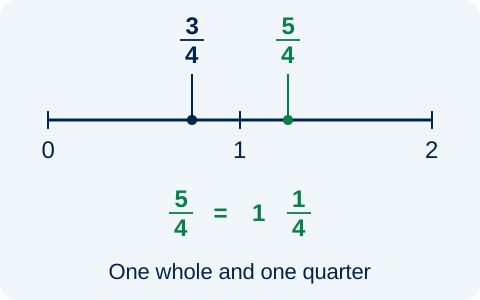
For example, has a position on the number line between and 1. Similarly, is greater than 1 and is equal to .
This way of thinking helps children understand fraction size before relying on calculations.
Consider and . Both are between and 1, and both are closer to . On a number line, sits slightly to the right of . A sketch can help visualise this comparison; equivalent fractions confirm it precisely.
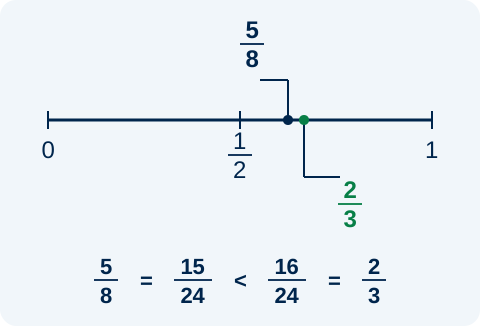
Benchmarks such as 0, , and 1 give children reference points. They can ask:
- Is this fraction above or below ?
- Is it close to 1?
- Is it greater than 1?
Equivalent fractions reinforce the same idea. , , and look different but represent the same value and occupy the same position on the number line.
A 2024 review found an association between number-line performance and broader mathematics performance, even after accounting for general cognitive ability. This supports the relevance of understanding number size, although the association alone does not establish which teaching method is best. (Ünal et al., 2024)
What to look for in your child's work
A wrong answer does not always mean the same thing. The type of mistake can reveal where the misunderstanding lies.
Choosing the largest numerator
If a child says is greater than because 5 is larger than 2, they may be applying whole-number thinking instead of comparing the fractions' values.
Choosing the largest denominator
A child who thinks is greater than because 8 is larger than 4 is making a similar mistake. When numerators are the same, a larger denominator actually means smaller parts.
Using a method without estimating
A child may correctly convert and into:
=
=
This gives the correct answer, but if they cannot estimate beforehand or explain why the result makes sense, they may be relying on a procedure without fully understanding fraction size.
Struggling with fractions greater than 1
A child may be comfortable with fractions such as but become uncertain with , , or . This can suggest that they still see fractions mainly as parts of one whole rather than as numbers that can extend beyond 1.
Recognising these patterns is important because different mistakes need different types of practice.
How to compare fractions meaningfully
Finding common denominators is an important method, but it should not be the only strategy a child uses.
Use a number line
Number lines make fraction size visible. Mark 0, , and 1, then ask where a fraction such as should go.
This also helps with fractions greater than 1. Seeing just beyond 1 makes its value easier to understand.
Compare with benchmark fractions
You can compare some fractions quickly using benchmarks.
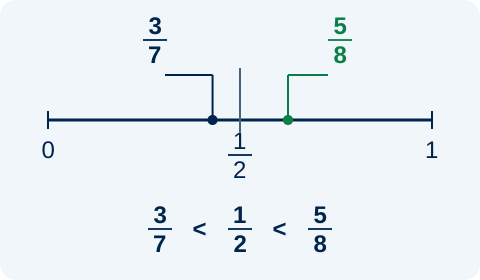
For example, with and , there is no need to find a common denominator. Since is less than and is greater than , must be larger.
This encourages children to choose a method based on the numbers rather than automatically applying the same rule every time.
Use equivalent fractions when needed
For and , using a common denominator confirms the estimate:
=
=
Therefore, is larger.
The calculation supports the child's understanding rather than replacing it.
Estimate before calculating
A useful habit is to ask:
“About where should this fraction be?”
If a child expects the answer to be slightly above , they can check whether their calculation is reasonable. Estimation helps catch mistakes and strengthens number sense.
Why fraction ordering is useful diagnostic practice
Ordering questions repeatedly ask the same important question:
How large is this fraction compared with another?
Because of this, they can reveal specific misunderstandings:
- A child who can order fractions with the same denominator but struggles with different denominators may need more work on equivalence.
- A child who always chooses the largest denominator may still be using whole-number thinking.
- A child who struggles only with improper fractions may need more practice placing fractions beyond 1 on a number line.
This is more useful than giving a child a general worksheet and hoping the problem improves. Practice is most effective when it targets the specific difficulty.
If ordering is the problem, practise ordering
In England, upper-primary pupils are expected to compare and order fractions, including fractions greater than 1. (Department for Education, 2021)
If a child can complete fraction calculations but still struggles to decide which fraction is larger, it makes sense to practise that skill directly.
The Fraction Ordering Practice Test Worksheets from DrillDown Prep provide focused practice comparing and ordering fractions with different denominators, helping children build confidence with common denominators and recognise fractions greater than 1.
Try fraction ordering practice
Download the free sample PDF to see the question format, or view the Fraction Ordering Practice Pack for more targeted practice.
References
- Ünal, Z. E., Terzi, Z., Yalvaç, B. & Geary, D. C. (2024). The relation between number line performance and mathematics outcomes: Two meta-analyses. Developmental Science, 27(4), e13509.
- Department for Education (2021). National curriculum in England: mathematics programmes of study. GOV.UK.