A child can be confident with addition, subtraction, multiplication and division, but still become uncertain when faced with a ratio such as:
For every 2 red counters, there are 3 blue counters.
The figures are simple enough. The problem lies in understanding the relationship between the numbers.
Ratio encourages children to go beyond thinking only about differences and to consider how quantities scale together. Learning to reason this way takes time (National Research Council, 2001).
The additive-thinking trap
Suppose Tom has 2 counters and Maya has 3. Maya has 1 more.
But if Tom and Maya's counters are in the ratio 2:3, doubling both quantities gives 4:6.
The difference is now 2. Double them again to get 8:12.
The difference is now 4, but the ratio stays the same: 3 for every 2. Both quantities can increase or decrease as long as you scale them by the same factor.
Ratios are made from equal parts
It may help to think of a ratio as consisting of equal-sized parts.
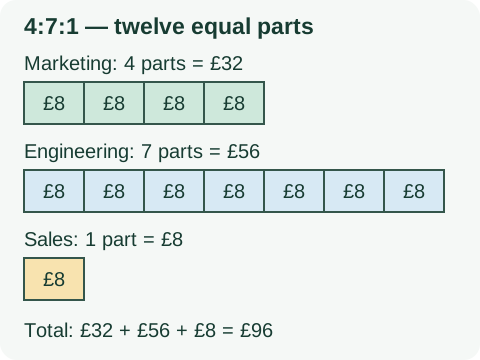
Suppose a company budget is shared between Marketing, Engineering and Sales in the ratio 4:7:1.
There are 4 + 7 + 1 = 12 parts.
If the total budget is £96: £96 ÷ 12 = £8 per part.
Sales has one part. Sales gets £8.
The bar model shows how the equal parts make up each department's share.
Why multi-part ratio questions become harder
The basic idea remains unchanged, but the information provided may differ.
In a new example using the same 4:7:1 ratio, suppose Sales and Marketing together receive £10. The total budget is no longer £96.
Together they represent 1 + 4 = 5 parts.
So £10 ÷ 5 = £2 per part.
Engineering has 7 parts: 7 × £2 = £14.
In a separate example, what if Engineering gets £24 more than Sales?
Their difference is 7 − 1 = 6 parts.
So £24 ÷ 6 = £4 per part.
Engineering therefore gets £28 and Sales gets £4—a difference of £24.
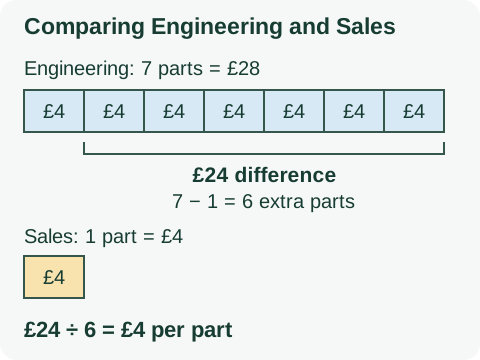
The calculations are simple; the difficult part is working out what the number in the question stands for—whether it represents all the parts, some of the parts, or the difference between two shares.
That is why a child can answer one ratio question with confidence but get stuck when the wording changes.
What to look for in your child's work
The wrong answers can show the specific misunderstanding.
Preserving the difference instead of the ratio
If a child changes 2:3 to 4:5, ask: “Does this still give 3 for every 2?”
Applying one method to every question
A child may automatically add all the ratio numbers and divide, even when the number given represents only two quantities or the difference between them.
Mixing up the parts
In our 4:7:1 example, Marketing has 4 parts and Engineering has 7. Label each share before calculating.
What helps children understand ratio
Counters and bar models can make the equal parts visible. Once that is clear, encourage the child to ask:
How much is one part worth?
It is also useful to check the answer by asking whether the same factor has scaled every quantity.
For example, if a ratio of 2:5 becomes 8:20, then
- 2 × 4 = 8
- 5 × 4 = 20
The same scale factor has been used, so the ratio is preserved.
Most importantly, vary the information in practice questions. Include totals, individual quantities, combined quantities and differences. This gives children practice interpreting the relationship rather than relying on one familiar question format.
Ratio in Year 6 and Grade 6
In England, ratio and proportion form part of the Year 6 mathematics curriculum, including relative quantities, scale factors and unequal sharing and grouping (Department for Education, 2021). These skills can also help with 11+ preparation where ratio questions are included.
The Common Core State Standards designate Ratios and Proportional Relationships as a separate area for sixth grade in the United States (Common Core State Standards Initiative, 2010).
Practise the reasoning that is causing the problem
For focused practice with these question types, try the Multi-Part Ratio practice pack from DrillDown Prep.
References
- Common Core State Standards Initiative. (2010). Common Core State Standards for Mathematics, Grade 6, pp. 39–42.
- Department for Education. (2021). National curriculum in England: mathematics programmes of study, Year 6. GOV.UK.
- National Research Council. (2001). Adding It Up: Helping Children Learn Mathematics, Chapter 7, pp. 241–244. National Academies Press.